Saturday, June 18, 2016

June 18, 2016: Guanaja, Bay Islands of Honduras

We raised anchor at daybreak on June 8, motored out of Governors Harbor, and raised sails as we headed towards the channel leading out of Grand Cayman's North Sound.  Our intention was to sail the 460 miles or so to Livingston, Guatemala.  But we had several potential intermediate stops if necessary. 


It was an excellent passage.  The wind was SE at 15 to 20.   We were heading WSW, so it was a fast, relatively comfortable reach.  We did 4 hour watches, and the nights passed easily.  On the second day, we crossed paths with several large freighters on routes between the Yucatan Channel and the Panama Canal.  Late in the day we passed the Swan Islands (Isla de Santillas.)  We never came close enough to see land, but a big lumbering Honduran military plane (maybe a DC3?) flew out from the island and circled us.  We waved.

Each morning we listen to Chris Parker's weather broadcast on the single sideband radio.  On the third morning, he spoke of winds building to 30 knots or more.  We were only 45 miles or so from Guanaja, the eastern most of the Bay Islands of Honduras.  So we determined to make the stop and rest for a couple days until the weather settled down.

And so we found Paradise.   Guanaja offers all the best of Caribbean landfalls.  It is a gorgeous mountainous island covered in pines and palms, and surrounded by clear blue water.  It has cheap good beer, free protected anchorages, friendly people, excellent food, abundant easily accessible great-tasting water, outstanding snorkeling (the healthiest, most diverse coral reefs we've found,) and mountain hikes with clear cool waterfalls.  


There are 8 other sailboats in our anchorage tonight:  three from France, two from Canada, one from England, and two from the U.S.  There are a couple of nearby restaurants where we gather, mingle with the locals, and try to tell stories in our respective languages.  It sounds like the Tower of Babel, but somehow we understand each other.

We took a three day circumnavigation around the island, staying for two nights in a beautiful quiet anchorage on the relatively unpopulated north side of the island. We celebrated our 32nd wedding anniversary there with margaritas in the cockpit.  No other sailors, no cell phone service, no internet, no radio traffic, but one really impressive sunset.  Excellent.


We kinda just wanna stay here.  If tribe and family were here, we would.  But we're now 8 days into our two day rest stop, hurricane season threatens, and we feel pressure to get to Rio Dulce.  Early tomorrow morning we will head west.  Our plan is to leave the boat in Guatemala, and return to the states for a couple months.  If things go according to plan, we'll be in Nashville on or about July 4.  Can't wait to see everyone!

Tuesday, June 7, 2016

June 7, 2016: Governor's Harbor, Grand Cayman

Jade flew into Montego Bay on May 16th, and three days later we were on our way to Jamaica's Blue Mountains.  Our goal was to climb Blue Mountain Peak.  At 7,402 feet, it is higher than any point east of the Mississippi in the U.S., and the highest point in Jamaica.

It is only about 80 miles from Oracabessa to Mavis Bank, the highest settlement on the mountain.  But it took all day to get there.  The mountain roads are incredible:  narrow, curvy, full of deep holes, and amazingly steep.  They drive on the left in Jamaica, and the steering wheel of our rental car was on the right, so I was constantly fighting my instincts and habits.  When trying to signal a turn, I turned on the windshield wipers instead. The road is wide enough for only one vehicle, but we regularly drove into the bushes when confronting cars (or trucks!) going the opposite direction at ridiculous speeds.  The road is often gravel or dirt, and a couple creeks must be forded.  There are a few terrifying bridges, 10 feet wide, with no railing, hanging 50 feet or more above a mountain gorge.  At one point, the road was so steep that the car would not go further until Maribeth and Jade got out and walked.  (I know, I know, it should have been my fat butt walking!)  Even after all that, we still could not drive to our planned destination.  A phone call, some haggling over price, and soon we were in a 4 wheel drive van, jostling and bouncing the last few miles to Jah B's Rastafarian hostel.  


Jah B's is an amazing place with a sublime view.  In addition to running the hostel for visitors to the Blue  Mountains, Jah B and his family grow organic vegetables and, most importantly, coffee plants.   (Blue Mountain coffee is among the best in the world.)

The crew of La Peregrina with Jah B, the Rastafarian hosteler and Blue Mountain coffee grower


We climbed out of our bunks at 1:30 a.m. and were soon hiking toward the summit.  Thick clouds develop over these mountains during most days, so our plan was to reach the peak for a sunrise panorama. The hike was extraordinary:  a cloudless night, a bright full moon, the lights of Kingston below.  But cold fog developed on the summit just as we arrived, and we were denied our view.  Still, it was a memorable adventure. 

We spent the remainder of Jade's visit exploring the north coast of Jamaica.  We sailed west from Oracabessa back to St. Ann's Bay, a vibrant community with a fascinating market, and then on to Falmouth Harbor and finally Montego Bay, which is called "Mobay" by the locals.  

We bid Jade a sad farewell on May 25th, but happily welcomed my sister Julie.  We stayed a few days anchored at the Montego Bay Yacht Club, where we enjoyed the showers, pool, bar, wifi, and restaurant.  I got my first haircut in 3 months, and we stocked up at an excellent grocery store.  
.
On Saturday, the 28th, we set sail for the Cayman Islands.  Julie was apprehensive, but proved to be excellent crew.  It was a two-day passage in relatively light winds dead astern, and we motored more than I preferred.

Grand Cayman is a pleasant place.  We tied up to a free mooring just off Georgetown for four nights where we found great snorkeling off the back of the boat.  An approaching tropical wave persuaded us to make the four hour trip around to North Sound and into well-protected Governor's Harbor, where we remain anchored today.  For eight days now, we have been enjoying the luxuries of this affluent island.  There is an excellent and inexpensive bus service that makes seeing the island easy.  We found a chandlery where I obtained proper parts to replace some of my temporary fixes.  We hiked the Mastic Trail and visited the Botanical Garden.  Maribeth made some outstanding meals with fresh tuna purchased from a local fisherman.  

The low pressure system has now moved north and become tropical storm Colin.  The winds are moderating here, and we are preparing to raise anchor and begin our passage to Guatemala.  It is about 450 miles, the longest crossing we have ever done without additional crew.   But the boat is ready, the forecast is good, we get daily updates via SSB, and we can stop in the Swan Islands or the Bay Islands of Honduras if necessary.  It might just be a blast!

We'll be out of touch for a few days. Best to all of you, and Happy Birthday to Tom Sharp.  We look forward to seeing you all soon.


Sunday, May 15, 2016

May 15, 2016: St. Ann's Bay, Jamaica

We've been in Jamaica for 24 days now.  20 of those days were in Port Antonio, where we found ourselves stuck waiting for a part to arrive for our diesel engine.  We stayed at Errol Flynn Marina, and the living was easy.  We had all the water we wanted, showers every day, a friendly and inexpensive bar, and an assortment of fascinating people.  Port Antonio is a gorgeous spot.  Mountains and clouds reminiscent of the Smokies hang over the town and its harbors.  It rains 300 inches a year there, which is six times what Nashville gets.  

To make a long story short, the motor is fixed and now runs better than ever.  We are sailing again, heading east a few miles at a time.  

We're getting to know this beautiful, funky, misunderstood island.  I think I expected gangsters.  Instead, we've found the people here to be friendly, polite, and religious.  Young men in their school uniforms help old ladies carry their groceries.  Young families in their Sunday best take pictures under breadfruit trees.  A few Jamaicans are desperately poor, and they are not hard to find.  A very few, we are told, are obscenely wealthy, but they keep themselves hidden away. 

We don't quite blend in when we visit these little Jamaican towns.  I haven't seen another white man in a few days now.  It's an experience, a perspective, more people should have.  The Jamaicans make us feel welcome.

We're off the beaten path now, and have been for a few weeks.  We rarely have other boats in our anchorages, and the few sailors we encounter seem more likely to be European or Australian than American.  

We are anchored tonight in the exact spot where Christopher Columbus anchored his boat to do repairs about 510 years ago. The water is 30 feet deep here, with flat land only 100 feet to the south, and a reef 100 feet to the north.  It is a unique, extremely well-protected and comfortable spot.

We're very excited that Jade is flying in tomorrow!  She'll be with us for 10 days, and we hope to see much more of Jamaica with her.  Then, my sister Julie will join us for our crossing to the Cayman Islands.

We are really missing tribe and family.  Can't wait to see you all!  We wish you the very best.  


Good night.

Sunday, April 24, 2016

April 24, 2016: Port Antonio, Jamaica

We were fortunate to have the opportunity to visit Cuba on a people to people exchange.  It is about 180 nautical miles from Great Inagua to Santiago de Cuba, with no place to stop along the way.  The route goes south 100 miles through the Windward Passage, and then turns west along Cuba's mountainous south coast for 80 miles.  The forecast called for east winds at 20 knots.  Perfect.   On April 12, we left Man of War Bay and sailed 100 miles south on a single port tack.  The first night brought stronger winds, uncomfortable seas, a squall, and scary ship traffic.  (I wish I'd added that AIS.) But the following day and night were wonderful sailing along a beautiful, seemingly uninhabited range of mountains. We found that the wind was more favorable, and the sea flatter, if we sailed close to the coast, so we gradually steered to within a mile and a half of land.  Then, we were honored to have the U.S. Coast Guard escort us 4 nautical miles offshore as we passed Guantanamo Bay.  They had a fast boat and a big gun, but were quite polite, so I put up no argument.  We arrived outside Santiago Harbor, below Castile de Morro, at daybreak.  We had some difficulty starting the motor, but finally dropped anchor at the marina at Punta Gorda by mid-morning on the 14th.

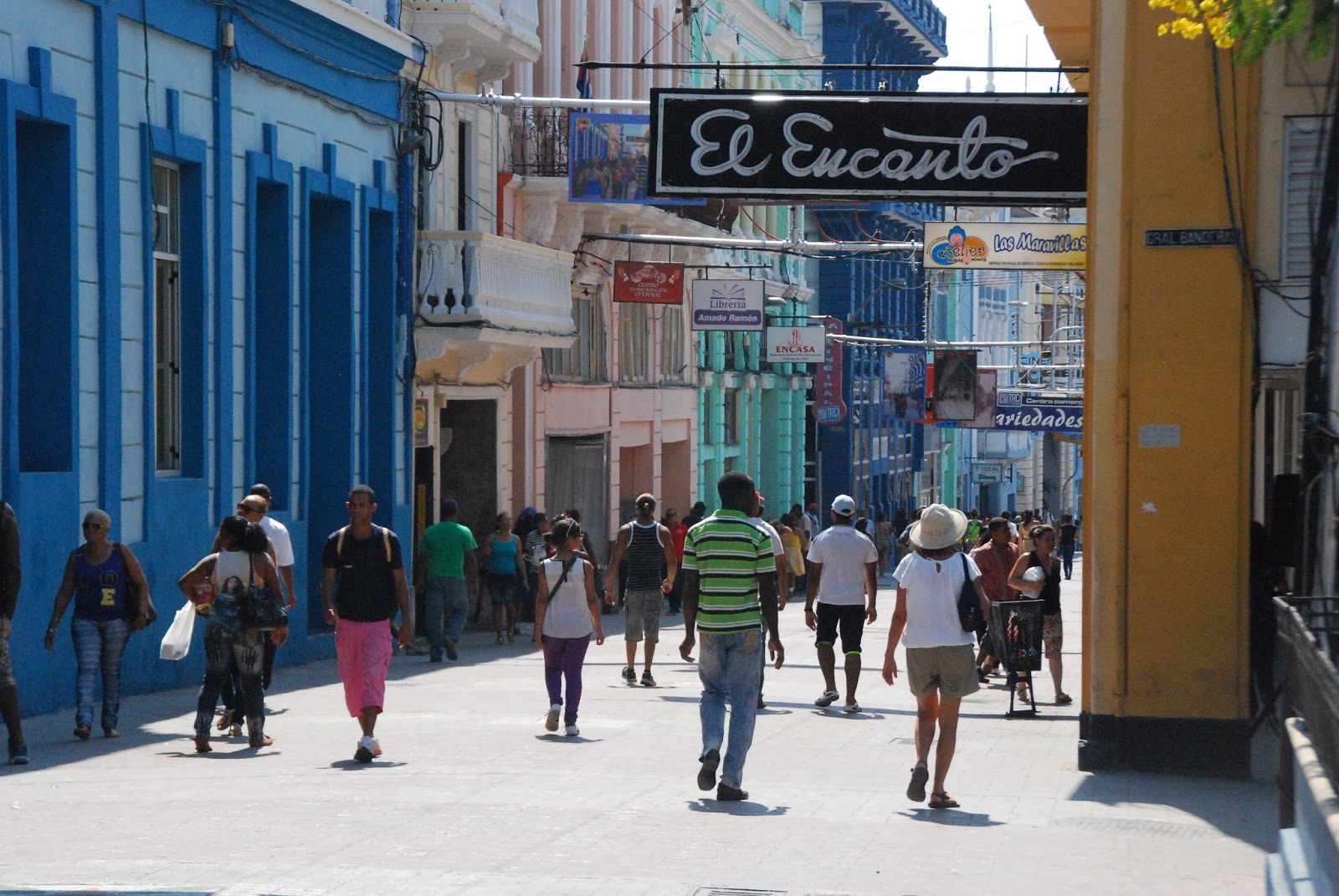
Cuba is a beautiful, fascinating country.  Unlike anywhere else on our voyage so far, Santiago de Cuba is surrounded by gorgeous mountains.  Nearby Pico Turquino is as tall as Clingman's Dome.  Santiago de Cuba has a reputation as a filthy industrial harbor, but we found it to be clean and attractive.  The people are friendly and hard-working.  Crime is essentially non-existent, and we always felt safe.  Of course, the socialist system works poorly and is rife with low-level corruption.  (A small tip here and there makes the system work better.)  Regular jobs don't pay enough to survive, so everyone - everyone - has some hustle going to make extra money.  Offering tourists special deals on cigars or rum, or leading you on a tour, or doing your laundry, or delivering jugs of diesel fuel, or bringing customers to a paladar (a privately owned restaurant, usually in someone's home) are common.  These are very enterprising people.  


A highlight  of our visit was being invited for dinner to the home of Pedro and Rosa and their three children Pochito, Roxanna, and Clara.  We had roast goat, a beautiful tomato and cucumber salad, potatoes, and rice and beans.  Maribeth brought a pasta salad and a bottle of wine.  Pedro poured two fingers of rum, straight up.  We struggled with language (our Spanish is worse than their English,) but managed to have a delightful evening, even managing conversations about religion and politics.  By our economic standards, Pedro and Rosa are quite poor.  But they are well-educated, curious about the world, open-minded, and amazingly resourceful. Wonderful people, and not so poor, really.


Shopping district in Santiago de Cuba


The Cubans have devised a rather clever money system involving two currencies.  There is the "CUC," pronounced "kook," exchangeable for other currencies and used by foreigners.  And there is the "peso national," used by the Cubans.  The effect is that foreigners pay much more than do locals for the same goods and services.  After a few days, we learned how to play the system and things got drastically cheaper for us.  We bought pizzas for 32 cents, ice cream cones for 8 cents, and splurged on large bottles of Havana Club rum for 6 dollars.

Regrettably, La Peregrina's motor issue got worse.  I could no longer start the motor.  The marina provided a diesel mechanic (no charge, though I privately tipped him $20) who determined that sea water was getting into the cylinders (but not, thank goodness, into the crank case.)  The diagnoses ranged from "motor finit," to a blown head gasket ("junta",) to a bad mixing elbow. 

So there we were in Cuba without a functioning motor, and no way to get parts.  (Americans cannot have parts shipped into Cuba.)  The Cubans assured us they could fabricate a head gasket or a mixing elbow, but they couldn't say how long it would take, or how much money.  Or, we could sail to Jamaica.  

As much as I despise running the motor, the prospect of sailing 115 nautical miles over open ocean and then entering an unfamiliar harbor in Jamaica without a motor was rather daunting.  There was no other good choice.

The wind blows out of Santiago harbor each morning, and the tide would also be falling on the morning of April 20.  We ensured the batteries were fully charged and the water tanks full, and unfurled the genoa at 9:00 am and drifted slowly toward open water.  In an hour we had sailed through the narrow harbor entrance and sat just offshore, bobbing for 2 or 3 hours in dead calm air.  Frustrated at noon, I opened a beer.  Immediately, the wind rose and we set off on a southerly course toward Jamaica.  Who says they don't brew good beer in Cuba?

The passage between Cuba and Jamaica was very pleasant.  Maribeth has been a very competent sailor for a long time, but now has gained confidence, and she put her skills to good use on this crossing.  We did 2 hour watches, and sailed fast through the night.  At dawn, we were three miles north of the Jamaican coast, with its tall mountains and, that morning, looming clouds and rain.  There, we hit a wall.  The wind suddenly died, or blew on our nose, though 8 foot northeast swells remained.  The current pushed us west.  We tried hard to make way in the right direction, but could not.  We sailed back north again, where we found the wind and made a second approach.  Once again, we got close to shore and we could see the waves crashing on either side of the entrance to Port Antonio, but we could not get there.

I surmised that we were fighting the morning land breeze and that the afternoon would bring a more favorable wind.  But Maribeth, who is smarter and less stubborn than me, chose not to wait.  She radioed Port Antonio's Errol Flynn Marina and soon the Jamaican Coast Guard was on its way to rescue us.  Four young men in an old 20 foot center-console motor launch soon appeared 50 feet to starboard. They had no lines, nor a proper cleat on their boat, and none of us knew precisely what to do.  I rigged a bridle on the bow, attached a spare halyard, and with all my strength tossed the loose end into the Jamaican boat.  Suddenly we were being towed, through the pouring rain, into the blessedly protected waters of Port Antonio.  I sat on the bow, watching the tow line go slack and then tighten like a guitar string.  Would it snap?  And if it did, which way would we drift?  "Joe, let's not tell anyone about this," Maribeth pleaded.  (Ah, but the truth will set us free.)

By 10:00 on the 21st, we were tied up at the Marina.  The senior coast guard officer, who may have been 25, came by our boat and had me sign a report describing the morning's event.  He was professional and friendly.   There would be no cost to us.  "This is our job.  We would do it again if you needed us."   Maribeth offered his crew a small bottle of Jack Daniels, which they accepted graciously.  I hired a mechanic, who has determined not only that the mixing elbow is bad, but that the turbocharger has been gone for a long time.  Parts are not available in Jamaica, so we must find parts and get them shipped here.

Errol Flynn Marina in Port Antonio, Jamaica.  La Peregrina is at bottom left, partially obscured.
In the meantime, Port Antonio is a gorgeous place; a beautiful harbor surrounded by the Blue Mountains with peaks more than 7000 feet tall. It has rained for three straight days, a radical change from the past three months.  The town is reported to have a population of about 13,000, though it seems smaller.  This is not where we planned or expected to be, but it is a good place, and we're having a blast.  

Clive the Banana Man stopped by our boat every morning, offering bananas and mangos for sale.
We are very hopeful we can find crew for our trip to Guatemala's Rio Dulce.  If you have interest, please let us know and we'll talk dates and locations.  We miss you all a great deal. 

Joe


Friday, April 8, 2016

April 8, 2016: Man of War Bay, Great Inagua

In a straight line, it is about 225 nautical miles southeast from Georgetown in the Exumas to Providenciales in the Turks and Caicos Islands.  But since the wind blows from the southeast, it is not a straight line, and therefore many more miles.

These are the remote out islands of the southern Bahamas.  They are largely unpopulated, and few sailors linger here.  To get to the Turks and Caicos, a sailboat must devise a zig zag route from island to island, using the available wind and considering tides and available daylight.  The islands are separated by 20 to 50 miles of deep open water.  Each leg is a serious passage, with no place to hide along the way.  After lazing around the Exumas for more than a month, this was a challenge for us.

We left Georgetown and Elizabeth Harbor at daybreak on Good Friday headed northeast.  La Peregrina was on a close reach and moving fast.  We sailed past our planned anchorage on Long Island, and arrived instead at Conception Island before cocktail hour.  


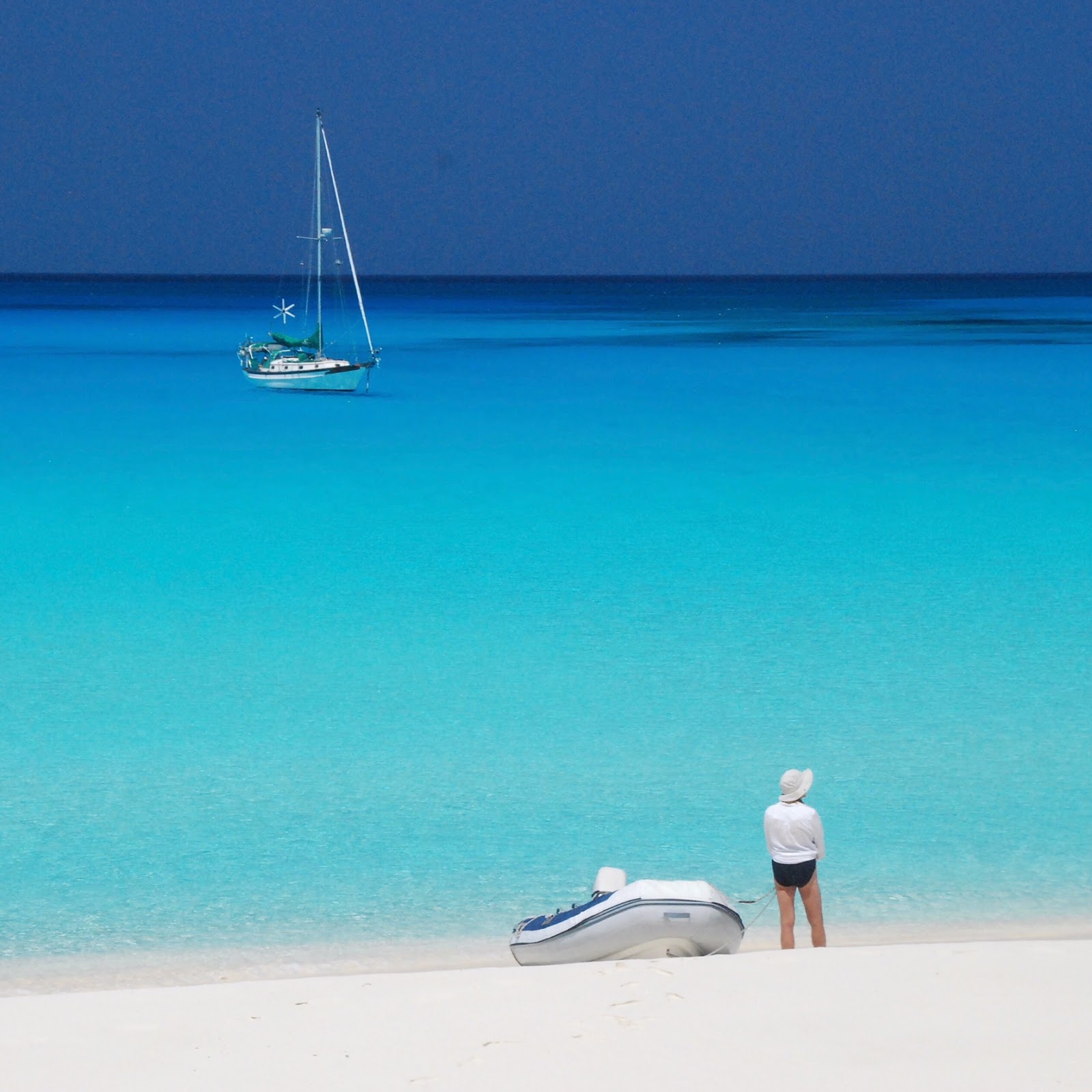
Conception Island is a very special place.  A Bahamian national park, it is uninhabited, completely undeveloped, and pristine.  It has amazing water colors, even by Bahamian standards.  The beach has the finest, softest sand I've ever encountered - like talcum powder.  We found an amazing petroglyph on a high rock overlooking the sea.  We saw nesting white-tailed tropicbirds and brown boobies.  We took the dinghy up a tidal creek full of sea turtles. On Easter Sunday, we built a fire on the beach as the sun set.   It was a moonless night, and while walking the beach under the stars, we kicked up thousands of tiny lights!  Bioluminescence in the sand!  Pixie dust!  Who knew such a thing existed?

My girls at Conception Island


From Conception, we had a pleasant day sail south to Rum Cay. But the islands were farther apart after that.  To have daylight both for leaving and entering anchorages, our sails became overnight passages.  It took four overnight sails spaced over six days to get from Rum Cay to Providenciales.   

On one of those overnights, I made a terrible mistake.  La Peregrina arrived just north of our planned anchorage at dawn in  25+ knots of wind.  I turned the key to start the motor, but nothing happened.  I was annoyed, but not terribly concerned.  Our chart book indicated a straightforward entrance to the anchorage from the north.  We decided we'd sail in without motor, drop anchor, get some sleep, and then figure out our starter problem.  

We were under reefed main and reefed jib as we approached the bank from the deep water, but we came in at more than 6 kts, with big winds and big waves.  It was light now, but the sky and the sea was grey.  Suddenly, we were in 20 ft of water, then 10, with poor light to see the bottom.  We furled in most of the jib, and Maribeth was at the mast, ready to drop the mainsail.  Without warning, there were breaking waves dead ahead of us!   Reefs all around!  MB shouted, “Tack.  Let's get out of here."  But there was not enough sail up, and not enough time.  I turned hard to windward, trying to stall the boat, but there was nothing to do at this point but hope the reef was deep enough.   It was not.   We hit hard, and spun sideways.  The boat made a terrible grinding noise, lifted high up, then leaned grotesquely.  Oh my God, we're shipwrecked.  So this is how our trip will end.   

Suddenly we were moving again.  A wave had picked us up and carried us off the reef.  We somehow managed to steer around a few more monster coral heads before finally finding a sandy spot to drop the anchor.   We were hobby horsing in 3 foot waves, but we were not taking on water and we had no apparent damage.  Soon, I found and repaired a loose starter wire, and got the motor running.  I had made a huge blunder, but had been given a pass.

In hindsight, it was foolish to enter an unfamiliar anchorage without a motor, without good light to see the reefs, and in heavy weather.   I should have hove to and fixed the starter, and had a "Plan B" anchorage lined up.   I learned, again, that you can't trust the charts or your chart plotter.  Trust only your own eyes! 

* * * * * * * * * *

Providenciales, more often called "Provo" by the locals, is a British possession, though their currency is the American dollar.   It is a significant stop for a couple of reasons.  First of all, with a population of 30,000, it is far bigger than any town we’ve visited since we left the U.S.  Maribeth did major provisioning for the first time in more than two months.  I gave La Peregrina some overdue attention.  We docked three nights at Caicos Marine, and I even hired a diesel mechanic who did in three hours what I would have spent a week figuring out.  Together with the crew from another boat, we rented a car and explored the island.  

Second, Provo is Important because it is where we had to decide which direction we go in the coming months.  Though most boats we've met are heading to the eastern Caribbean, we have decided to turn south and west through the Windward Passage with the goal of reaching Rio Dulce or Panama by the start of hurricane season.  This means we'll finally have the wind behind us, and it means we'll need to practice our Spanish.  Yesterday, with La Peregrina busting at the seams with food and supplies, we left Provo and sailed overnight to Great Inagua, where we will rest up before heading south again.

There will be opportunities to join us in the next 2 or 3 months.  We'd love to share our little adventure with you!

Joe

p.s.  Molly helped us set up an Instagram account.  Check us out at SailLaPeregrina.

Thursday, March 24, 2016

March 24, 2016: Fowl Cay, Elizabeth Harbor, Exumas

We were sad to see Molly leave us yesterday, after 10 wonderful days of Bahamian adventure. We sailed back north, this time in familiar waters.  We chased eagle rays at Lee Stocking Island, saw a mermaid playing piano at Rudder Cut Cay, celebrated St. Patty's Day with rum punch at Staniel Cay, explored underwater caves at Rocky Dundas, cleaned up at Rachel's Bubble Bath, and snorkeled with turtles, squid and a hundred variety of colorful fish off O'Briens Cay before completing a 60 mile overnight sail back down Exuma Sound to Georgetown. 


Georgetown is a fascinating place.  When we first arrived in early March, there were 500 sailboats anchored in the harbor.   At night, the anchor lights resemble a small city.  And like a city, the days here have a predictable rhythm.  At 8:00 am each morning, the "cruisers net" - emceed by a rotation of volunteers - starts on VHF 72.   Hundreds of sailors huddle by their radios to get the latest secondhand weather forecast, discover what specials local businesses are running, and learn what time and on what beach someone will be leading yoga lessons or organizing a volley ball tournament today.  Boats newly arrived in the harbor are invited to introduce themselves, and departing boats can say a public goodbye.


I listen with interest when sailors are invited to announce what they'd like to buy, sell, or trade.  Copper Penny is leaving and has unneeded crackers.  The crew of Last Tango will fly back to the states for a few days and needs someone to look after the boat dog.  Tacks Free is renting a car today, and will be heading to the airport at noon if anyone needs a ride.  Mother Goose needs a rigger.  Morse Code needs parts for his Raritan toilet (Still? Poor guy.)

It has been 75 days now since we left New Orleans aboard La Peregrina.  During this time, we've spent 9 nights in a marina (all in the first month,) 6 nights underway at sea, 5 nights on mooring balls, and 55 nights at anchor.  We've put 254 hours on the motor and used 140 gallons of diesel.  We arrived in the Bahamas on February 4th.  In the 50 days since, we've had 20+ kts of wind on 28 days.  It has rained twice, both times lightly and for less than 30 minutes.   We've had a bunch of little mechanical, electrical, and plumbing issues, but nothing significant.  Yet.

It is time for us to leave the Exumas. We're anchored tonight off Fowl Cay, at the eastern edge of Elizabeth Harbor.  The swell from Exuma Sound swings around this little island.  La Peregrina rocks and rolls, and her spars and halyards slap and bang.  But the anchor is well set, our stomachs are full, there is wine in our glasses, and a giant moon just rose in the east.  It's not a bad evening.

At dawn, if things go as planned, we'll set sail for Calabash Bay, on the north end of Long Island.  

We miss all of you, and continue to hope you'll find a way to join us.  To our Nashville tribe,  don't forget that Saturday is the annual Spring Walk from Percy Priest Dam to downtown via Nashville's greenways.  We regret we can't join you this year, but we'll drink a beer and think of you.


Friday, March 11, 2016

March 11, 2016: Georgetown, Exumas, Bahamas

We spent two and a half weeks island-hopping south through the Exumas.  No longer focused on a far-off destination, our pace slowed significantly.  We slept late, lounged with coffee in the cockpit, and each day eventually went somewhere or did something.  Some days it was walking the trails on nearby islands.  We saw iguanas on Allan's Cays, and climbed Perry Peak, the highest point in the Exumas at 123 feet.  Some days it was a boat chore.  We scraped barnacles off the bottom one day, and cleaned stainless steel another.  Some days we sailed to the next island.

The Exumas are a chain of many islands running more than 100 miles from NNW to SSE in the central Bahamas.  To the east of these islands is Exuma Sound, many thousands of feet deep and completely open to the prevailing winds.  Deep blue and windy.  To the west is the Bahama Bank, rarely more than 20 feet deep, sometimes less than 5 feet deep, and protected from waves if not wind.  Every shade of blue, green, turquoise and white. There are many cuts allowing passage between the Bank and the Sound, so the sailing route can vary day-to-day, depending on the latest weather forecast. 

Mostly, we sailed down the west (Bank) side of the Exumas.  Most islands are uninhabited.  They offer gorgeous anchorages, with empty beaches, palm trees, reefs, and caves.   A few, like Staniel Cay, Black Point, and Little Farmer's Cay, have tiny settlements.  Little Farmer's, we were told, had 39 people "including the children."  You can buy Kalik for $5 a bottle in any of them.

Typically, we anchored with 5 or 6 other sailboats.  Many became familiar.  There was Last Tango (Texas) and Pepper (Montana) and La Luna (Holland) who had been with us at Gun Cay more than a month ago, and who we had cocktails with tonight.  There was Lala and Oddysey (both from Ontario) who we grilled dinner with on the beach.  

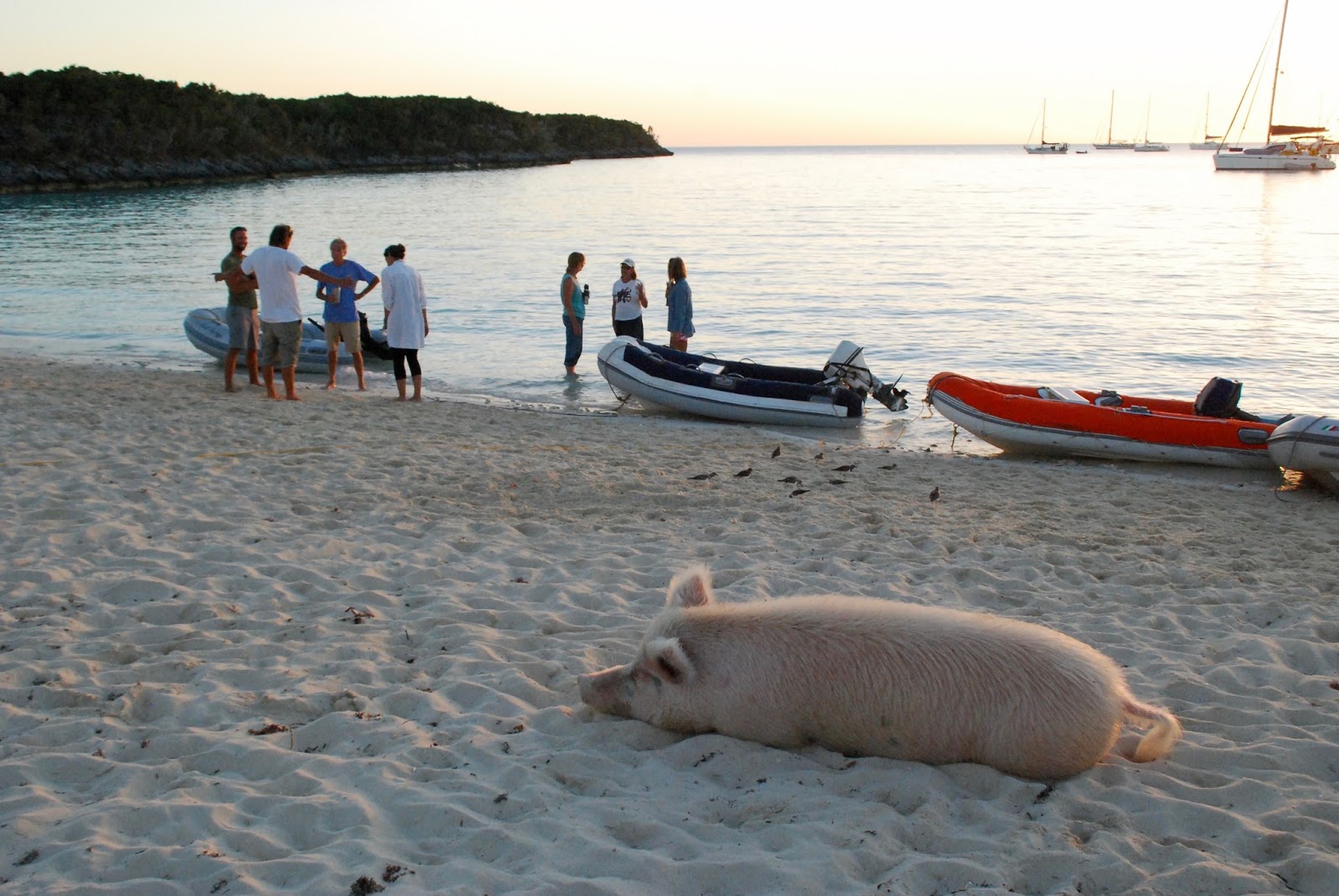
The one discipline that unites all Exumas sailors is 5:00 cocktail hour.  The default, if no specific arrangements have been made, is to meet on the beach.  Everyone brings a beer or a glass of wine or a rum drink.  We stand in the sand, or ankle deep in the water, discussing our plans and seeking advice.  At 6:15 or so, we marvel at the sunset.  Then everyone climbs back in their dinghies and returns to their boats.  

Cocktail Hour at Big Major's Spot, Exumas


For the past week, we've been in greater Georgetown.  With a population approaching 1000, Georgetown is by far the largest community in the Exumas.  The town is fronted by Elizabeth Harbor, where a few hundred sailboats are anchored.  A dinghy ride under the 8 ft high, 10 ft wide bridge into Lake Victoria brings you to the Exuma Market dinghy dock.  Here, you can get all the free water you can carry.  And it's a very short walk to a grocery store, hardware store, gas station, liquor store, hamburger joint, internet cafe, and hair salon.  What more could you possibly want?


Georgetown is a pleasant town, full of pleasant people.  Businesses are creative:  The woman who cut my hair (finally!) also sold us some grouper her husband had caught.  And the Internet cafe I used to upload a video also sold snacks and offered "crystal hair treatments with Indian Henna," whatever that is.

We thoroughly enjoyed a Friday evening at Redboone, a roadside beer and hamburger stand where a local band played standards under the stars.  Locals and sailors talked and sipped and tapped feet and danced together.  The Bahamians were black, happy, loving, well-dressed, welcoming. We sailors were unshaven, sunburnt, sloppily-dressed (except for Maribeth, who was absolutely stunning that evening,) tight with our money, and thrilled to be there.   Fun, it seemed to me, was had by all.

Don't worry
About a thing
'Cause every little thing's
Gonna be alright

Molly arrives on Sunday!  We can't wait to see her.  We plan to sail back north, hoping to show her parts of the Exumas we've enjoyed the most and, maybe, discover some new favorites.

We hope everyone is doing well back home.  Come see us!

Good night.